- 01. Why hall lighting works against you
- 02. The four lighting jobs every booth needs
- 03. Spec sheet: what to actually order
- 04. Power: the thing nobody plans for
- 05. Common lighting mistakes
- 06. What it costs
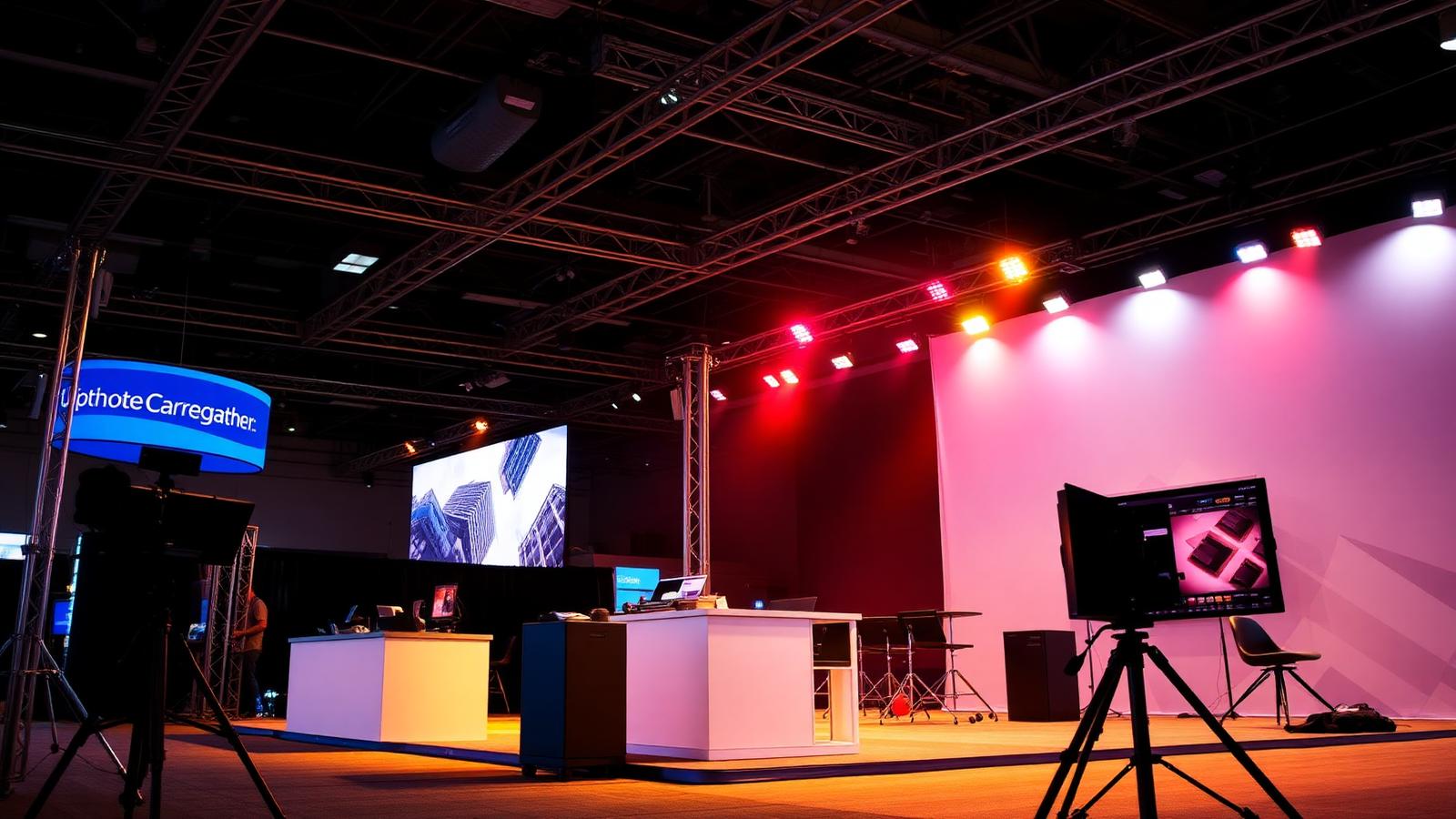
Walk any trade show floor and you can spot the booths that took lighting seriously from 50 feet away — and the ones that didn't, even if they spent twice as much on graphics. Halls are lit for safety, not for branding, with that cool overhead fluorescent that flattens every color and washes out faces. If you don't bring your own light, you're handing your booth's first impression over to the convention center's electrician. Here's how to think about booth lighting like a pro.
Why hall lighting works against you
Most convention halls run cool 4000–5000K overhead lighting at roughly 30–50 foot-candles — bright enough to walk safely, but completely wrong for showing off product, video, or brand color. Whites turn slightly blue, warm tones go gray, and any backlit graphic on your booth competes with bright ambient light instead of standing out.
The fix isn't more light — it's directional, warmer, and well-placed light that contrasts with the ambient and pulls the eye toward what matters: your headline, your product, and your people.
The four lighting jobs every booth needs
- Brand wash — Even, color-accurate light on your main backwall graphic so colors read true. Track lights or LED bars work well.
- Product spots — Tight beams (15–25°) on hero products to make them visually pop. This is where dramatic shadows sell.
- Counter / engagement light — Warm, even light on demo counters and meeting areas so faces look good and people feel comfortable lingering.
- Accent / atmosphere — Color-tunable LED strips, halo backlights behind logos, or glow under counters to add depth and a premium feel.
Spec sheet: what to actually order
For a 10×10 booth, plan for around 4–6 fixtures total. For 10×20, double that. The cheapest reliable setup: a handful of LED arm lights clamped to the top of your backwall, aimed at your graphic. Add 2 small spots on a counter and you're already ahead of 80% of booths. Rental pricing varies by vendor and city, so ask your builder or lighting vendor for a couple of options at different price points.
Key specs to ask your builder or lighting vendor about: color temperature (3000K for warm/premium, 4000K for neutral, avoid 5000K+), CRI (≥90 for accurate brand color), and beam angle (narrow for spots, wide for washes). Dimmable is worth paying extra for — it lets you tune to the room.
Power: the thing nobody plans for
Show power is ordered separately from your booth space and it's expensive — pricing scales with wattage and varies by venue. Order it early; advance pricing is meaningfully cheaper than on-site rates at most shows. Make sure your total wattage (every fixture + monitors + chargers) fits within what you've ordered, with about 20% headroom.
Bring power strips, gaffer tape (not duct tape — it pulls up carpet), and at least 25 feet more extension cord than you think you need. The drop is rarely where you want it.
Tell us about your event, budget, and timeline. We'll line up vetted booth builders that fit — usually within 48 hours, no commitment.
Get matched with buildersCommon lighting mistakes
- Lighting from above only — creates harsh facial shadows on staff and visitors.
- Ignoring backlit logos — a halo-lit logo is typically the single most premium-looking upgrade per dollar.
- Mixing color temperatures — warm spots next to cool washes looks amateur. Pick one temperature family.
- Forgetting the floor — a single uplight in a corner doubles the perceived booth size.
- Skipping a dimmer — full brightness during setup and quiet hours is harsh and burns out your team.
"We added a small lighting rental to an otherwise modest booth and people stopped to ask who built it. The next year we doubled down on lighting and cut graphics spend in half — same booth size, way better engagement."
What it costs
Lighting cost varies more than most exhibitors expect — it depends on booth size, fixture count, fixture type (basic LED arms vs. truss-mounted moving heads), whether you rent or buy, and the local rental market. The fastest way to gauge what's reasonable for your booth is to get a couple of quotes from your builder and a lighting-only vendor and compare what's included. Buying your own kit usually makes sense once you exhibit several times per year.
If your booth builder is quoting lighting as a flat add-on, ask for the line items. You should see fixtures, gels/diffusers if any, dimmer/controller, install labor, and electrical drops broken out.
- Hall lighting is wrong for branding — bring your own directional light
- Cover four jobs: wash, spots, counter, accent
- Spec 3000K, CRI ≥90, dimmable fixtures for premium feel
- Order show power early — advance rates are meaningfully cheaper than on-site
- Backlit logos are the single best per-dollar upgrade
Download the Exhibit Bridge Booth Buyer's Guide
Budgets, timelines, vendor red flags, and the exact questions to ask before signing a booth builder contract.
Ready to find the right booth builder?
Skip the cold-calling. Tell us about your show, your booth size, and your budget — we'll send a short list of builders worth your time.
Part of the Exhibit Bridge editorial team — ex-exhibitors, marketers, and builders writing the guides we wish we'd had when we were on the show floor.
Zoom out to the full playbook
This article is part of a deeper hub — the pillar page collects every related guide on the topic.
Plan around your show, city, and industry
Use these directories to pressure-test the guide against your specific show, venue, and vertical.
Keep reading
Reusable booths, recycled materials, carbon-neutral shipping — what's worth paying for, what's marketing, and how to build a booth your sustainability team will actually approve.
Six graphic-design rules that make modular booths look custom — and the mistakes that make them look like a generic kit.
The shipping method choice that quietly determines whether your booth makes it to the show floor on time.