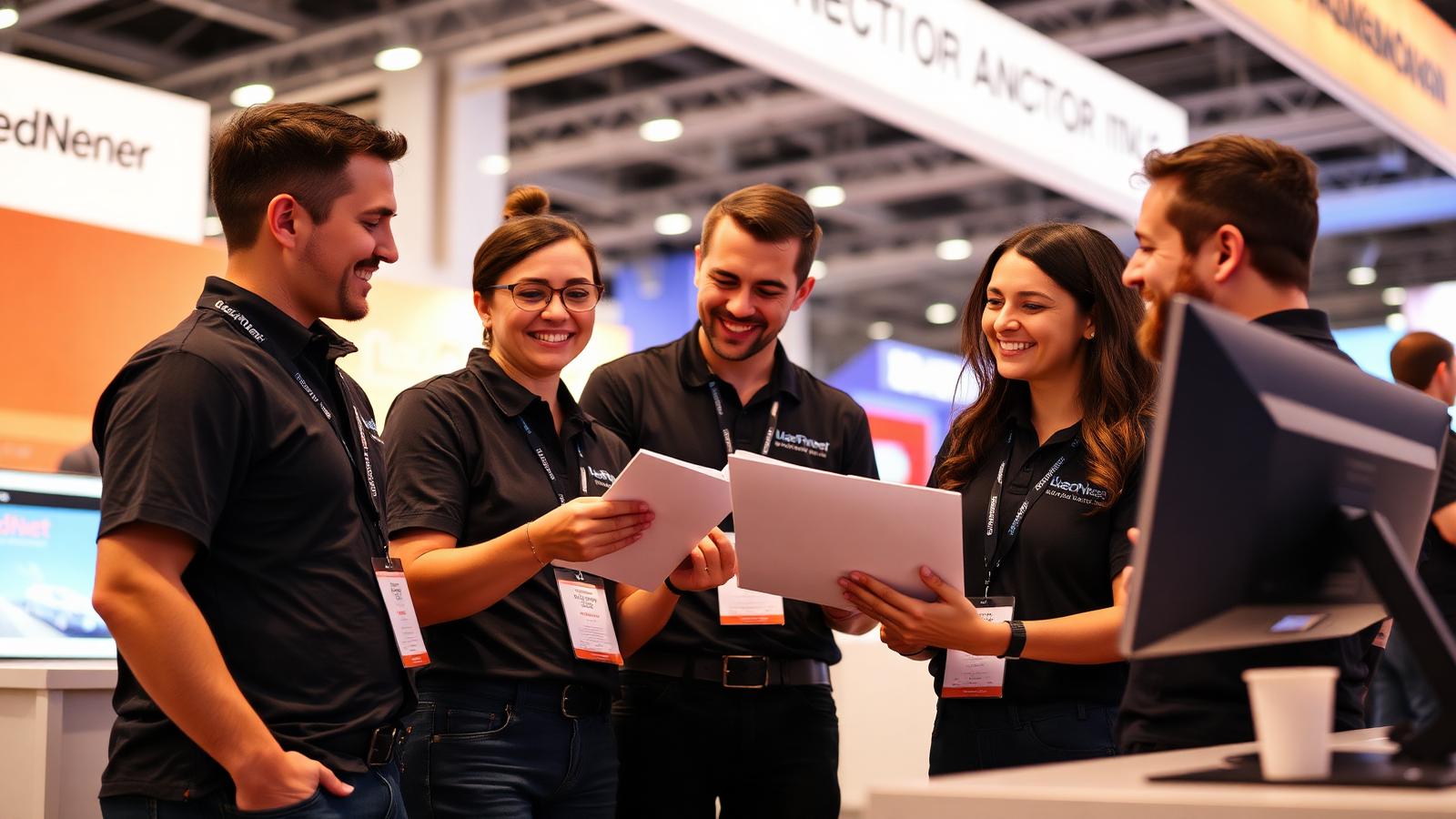
- 01. How many people you actually need on the booth
- 02. The four roles every booth needs
- 03. Sales reps vs. SDRs vs. product people
- 04. The 60-minute pre-show training that changes everything
- 05. What good booth body language looks like
- 06. Daily debriefs and mid-show course corrections
Most exhibitors spend 90% of their planning energy on the booth itself and 10% on the people standing in it — then wonder why the leads were thin. Staff is the single biggest variable in trade show ROI, full stop. A mediocre booth with a sharp, trained team will out-convert a beautiful booth with bored sales reps every single time. Here's how to staff a booth that actually closes.
How many people you actually need on the booth
The working ratio is one staffer per 50 square feet of open booth space, plus a floater. A 10x10 needs two people on the floor at all times. A 10x20, three. A 20x20 island, four to five. Anything less and you'll miss conversations during peak hours; anything more and you'll cluster behind the counter looking unapproachable.
The mistake is staffing for total bodies, not concurrent bodies. If your booth is open 9 hours a day for three days, that's 27 booth-hours. With two-hour shifts (longer than that and energy collapses), a 10x20 needs roughly six unique people across the show to keep three on the floor in rotation. Plan for breaks, lunches, and one person down with a cold.
The four roles every booth needs
Even a small booth benefits from explicit role assignment, not 'everyone does everything.' The roles:
- Greeter / qualifier — owns the booth perimeter, opens conversations, asks the qualifier
- Demo lead — runs the product walk-through, owns the demo station
- Closer / scheduler — books the next-step meeting before the visitor walks away
- Floater / captain — watches the floor, steps in when someone needs a break, handles the unexpected
On a 10x10, one person plays greeter+qualifier and the other plays demo+closer. On a 20x20, you separate all four. The captain role is the one most exhibitors skip and most regret skipping.
Sales reps vs. SDRs vs. product people
Conventional wisdom says staff the booth with senior account executives. The honest answer is more nuanced. AEs are good at closing once a conversation is qualified, but they often resist the high-volume, low-qualification opening conversations a booth requires. SDRs and product marketers are usually better greeters because the energy of asking the same opening question 200 times doesn't drain them.
The right mix for most B2B booths: SDRs or product marketers on the perimeter, AEs at the demo or in scheduled meetings, one founder or executive on the floor for the marquee conversations. Do not staff a booth entirely with AEs unless your show is genuinely all enterprise-buyer conversations.
The 60-minute pre-show training that changes everything
Run this the evening before day one, not the morning of. One hour, four parts:
- 15 min — the qualifier and the demo flow, demonstrated and role-played
- 15 min — booking the next step: exact language for offering a calendar invite at the booth
- 15 min — what disqualifies a lead (so reps stop wasting time on tire-kickers)
- 15 min — Q&A and assignments: who's where, when, and what their target is
Give every staffer a one-page cheat sheet with the qualifier, the disqualifiers, the booking script, and the daily targets. Most teams skip this and improvise. The teams that don't skip it convert 2–3x better.
Tell us about your event, budget, and timeline. We'll line up vetted booth builders that fit — usually within 48 hours, no commitment.
Get matched with buildersWhat good booth body language looks like
Don't sit. Don't stand behind the counter with arms crossed. Don't stare at your phone. Don't eat in the booth. These feel obvious in writing and are violated within an hour at every show.
What works: stand at the open edge of the booth, weight forward, eye contact with passing traffic, neutral smile. Open the conversation with an actual question, not 'how's your show going?' Something like 'Have you seen [the product / the demo] yet?' or 'What brought you down this aisle?' opens far better than the generic greeting that signals 'I'm a salesperson.'
Daily debriefs and mid-show course corrections
End each show day with a 15-minute team huddle. Three questions: what conversations worked, what didn't, what should we change tomorrow. Write down decisions and brief the morning team before doors open.
The teams that improve day-over-day are the teams that treat the booth as iterative. The teams that don't huddle deliver day three the same way they delivered day one — usually with declining energy and no learnings carried forward.
- Plan one staffer per 50 sq ft on the floor at all times — not total headcount
- Assign explicit roles: greeter, demo lead, closer, captain
- SDRs and PMMs often outperform AEs on the booth perimeter
- Run a 60-minute training the night before day one — every time
- Daily 15-minute debriefs are the single highest-leverage habit
Download the Exhibit Bridge Booth Buyer's Guide
Budgets, timelines, vendor red flags, and the exact questions to ask before signing a booth builder contract.
Ready to find the right booth builder?
Skip the cold-calling. Tell us about your show, your booth size, and your budget — we'll send a short list of builders worth your time.
Part of the Exhibit Bridge editorial team — ex-exhibitors, marketers, and builders writing the guides we wish we'd had when we were on the show floor.
Zoom out to the full playbook
This article is part of a deeper hub — the pillar page collects every related guide on the topic.
Plan around your show, city, and industry
Use these directories to pressure-test the guide against your specific show, venue, and vertical.
Keep reading
Reusable booths, recycled materials, carbon-neutral shipping — what's worth paying for, what's marketing, and how to build a booth your sustainability team will actually approve.
Lighting is the single highest-ROI upgrade you can make to a booth. Here's how to plan it, what to spec, and the mistakes that wash out your brand.
Six graphic-design rules that make modular booths look custom — and the mistakes that make them look like a generic kit.