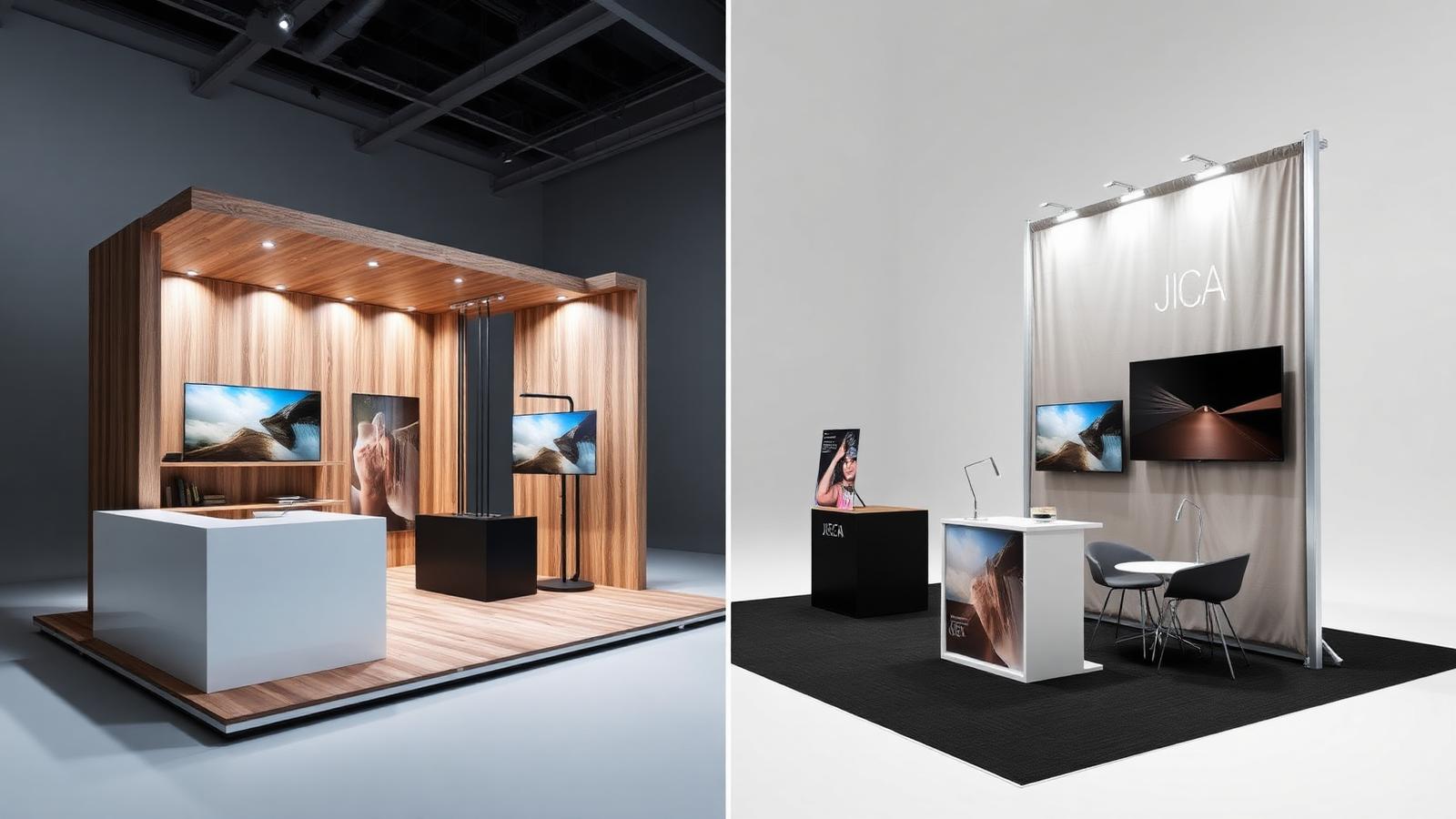
- 01. The real definitions (most articles get this wrong)
- 02. Cost over 1, 2, and 5 shows
- 03. Lead time and last-minute changes
- 04. Brand impact: when custom genuinely wins
- 05. Modular doesn't have to look cheap
- 06. Hybrid approaches that get the best of both
The custom-vs-modular debate is older than the modern trade show industry, and it still trips up exhibitors every year. The honest answer is that neither is universally better — they solve different problems, and choosing the wrong one for your situation is what makes exhibitors feel like they wasted money. Here's the comparison across the dimensions that actually matter: total cost over multiple shows, lead time, brand impact, and what each one quietly does to your shipping and storage bill.
The real definitions (most articles get this wrong)
Custom booths are designed and fabricated specifically for one client, typically using a mix of wood, metal, fabric, and bespoke graphics. They're not reusable in the same form for a different brand, and adapting them to a new layout usually requires significant rework.
Modular booths are built from a system of standardized components — aluminum extrusion, fabric panels, connector pieces — that can be reconfigured into different shapes and sizes. The system is the product; your specific booth is just one configuration of it.
There's also a third category that gets ignored in most comparisons: hybrid. A hybrid booth uses a modular skeleton with custom-fabricated accent elements (a custom reception desk, a custom-built demo station, a bespoke ceiling treatment). For most exhibitors who do 3+ shows a year, hybrid is the right answer and they don't know it exists.
Cost over 1, 2, and 5 shows
For a single show, modular is almost always cheaper. Custom booths cost noticeably more than a comparable modular booth at the same footprint, and the spread between the two depends heavily on the design, the materials, the show city, and the builder. Get quotes from a couple of builders in each category if you want a real sense of where your specific project lands.
Over two shows the gap narrows because custom booths can usually be reused with new graphics at a fraction of the original build cost, while modular reconfigurations cost roughly the same each time. By the third show, custom can pull even or ahead — assuming the design still feels current and the structure is in good shape after travel.
Over five shows, the answer depends on whether your booth needs to grow or change layouts. If you're locked into the same configuration for years, custom tends to win on cost-per-show. If you need to change footprints (10x10 at one show, 20x20 at another), modular wins because you can reconfigure without scrapping hardware.
Lead time and last-minute changes
Modular booths can ship in 4–6 weeks from order, sometimes faster if the components are in stock. Custom booths need 12–16 weeks minimum, and changes mid-build are slow and expensive.
If your event calendar is lumpy — shows added with short notice, layout changes from the show organizer — modular gives you flexibility that custom can't match. If your calendar is stable and your design is locked, custom rewards the longer planning cycle with a more distinctive result.
Brand impact: when custom genuinely wins
Custom wins when distinctiveness is the entire point. Consumer-facing brands at events like CES, premium B2B brands trying to look like the category leader, and any company whose product itself is the booth experience (think automakers, hospitality groups) all benefit from custom.
Custom doesn't win for B2B sellers whose buyers care more about who's in the booth than how it looks. For many enterprise software, professional services, and industrial component vendors, a clean modular booth with strong messaging outperforms a custom booth with mediocre staff. Spend on the experience inside the booth before the booth itself.
Tell us about your event, budget, and timeline. We'll line up vetted booth builders that fit — usually within 48 hours, no commitment.
Get matched with buildersModular doesn't have to look cheap
The case against modular has historically been that it looks like every other booth on the floor — fabric over aluminum, the same graphic walls, predictable proportions. Recent systems have closed most of that gap. Aluvision and beMatrix in particular can produce booths that read as custom unless you know what you're looking at.
The trick is to invest the savings into things modular doesn't include by default: real lighting design, a custom reception or demo element, and high-quality graphic production. A modular booth with a meaningful slice of the budget redirected into well-designed accents will outperform an all-modular booth of similar total cost in nine cases out of ten.
Hybrid approaches that get the best of both
The hybrid sweet spot for most growth-stage B2B exhibitors looks like this: modular structure for walls, ceiling grid, and storage; custom-fabricated reception desk or demo station; custom lighting integration; high-end fabric or backlit graphics. You get the reconfigurability and shipping economy of modular plus the distinctiveness of custom on the elements people actually look at.
The downside of hybrid is that fewer builders do it well. Pure modular shops will sell you a kit and say 'add custom wherever you want.' Pure custom shops will quietly try to make the whole thing custom. You want a builder who has built actual hybrid booths recently and can show you photos.
- Single show: modular almost always wins on cost
- 3+ shows with stable design: custom can pull ahead per-show
- Footprint changes year to year: modular's flexibility is hard to beat
- Hybrid (modular skeleton + custom accents) is underused and often optimal
Download the Exhibit Bridge Booth Buyer's Guide
Budgets, timelines, vendor red flags, and the exact questions to ask before signing a booth builder contract.
Ready to find the right booth builder?
Skip the cold-calling. Tell us about your show, your booth size, and your budget — we'll send a short list of builders worth your time.
Part of the Exhibit Bridge editorial team — ex-exhibitors, marketers, and builders writing the guides we wish we'd had when we were on the show floor.
Zoom out to the full playbook
This article is part of a deeper hub — the pillar page collects every related guide on the topic.
Plan around your show, city, and industry
Use these directories to pressure-test the guide against your specific show, venue, and vertical.
Keep reading
Cancellation clauses, IP ownership, hidden labor markups, and the booth builder fine print that costs exhibitors thousands every year.
A 10-question framework for vetting rental partners — most exhibitors only ask 3.
The 6 milestones every custom booth project moves through — and the 3 where most projects slip.